
Read time: 3 minutes.
Clinical trials show us whether a new treatment is safe and effective. They are also an important way for patients to access cutting-edge care. For trials to truly serve the lung cancer community, the people who enroll in the trials need to represent the populations who are diagnosed in everyday life.
Recognizing these needs, federal agencies like the United States Food and Drug Administration (FDA) have been encouraging clinical trials to offer more locations across the US.
The Plan
The intention is that a broader footprint of clinical trials can reduce barriers for patients and help studies include a larger range of participants that reflect the real world. It’s better for the patients and it leads to stronger science. But LUNGevity’s latest research suggests the opposite is happening.
The Reality
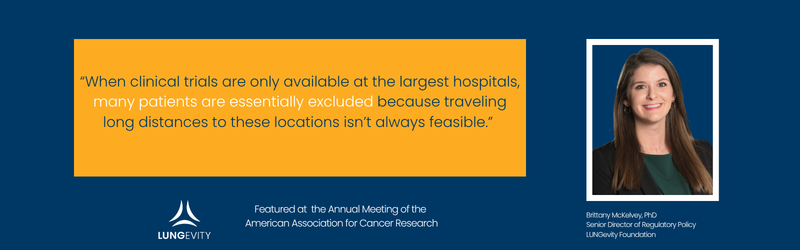
“When clinical trials are only available at the largest hospitals, many patients are essentially excluded because traveling long distances to these locations isn’t always feasible,” said Brittany McKelvey, PhD, lead author on the study and LUNGevity’s Senior Director of Regulatory Policy.
To understand how trial access is changing, LUNGevity researchers examined ClinicalTrials.gov data for early-phase non-small cell lung cancer (NSCLC) trials run by biopharmaceutical companies. They focused on trials that enrolled patients between 2020 and 2024. Altogether, the dataset included 555 trials conducted across 47 countries.
New research from LUNGevity’s Transforming Clinical Trials Initiative (TCTI) highlights a disturbing trend: As clinical trials are becoming more concentrated in fewer locations, many patients may lose access to cutting-edge treatment.
While the US still hosted a large share of these trials compared to other countries, the number of US sites opening new trials declined significantly during the study period. The sites that continued to have a high number of trials were mostly large, academic medical centers in major cities, showing that early-phase NSCLC trials are becoming more concentrated in fewer locations.

This reduces access to next-generation treatments for patients in rural areas and for those being treated in smaller hospitals or cancer clinics.
This compelling research was showcased at the annual meeting of the American Association for Clinical Research (AACR) in April 2026 with a special press release, poster, and white paper to provide more details.
The Impact on Patients
For patients, this pattern of consolidating clinical trial sites impacts which treatment options are realistically available. If a trial is only available at a handful of institutions, participation may require repeated trips to a major city—something many people simply can’t manage because of time, cost, work, caregiving responsibilities, and/or their health.
“Distance shouldn’t determine whether someone can participate in a clinical trial,” said McKelvey. And when participation skews toward those who can travel, it becomes harder to build studies that reflect the full range of people living with lung cancer.
Making it Better for Patients
LUNGevity’s Transforming Clinical Trials Initiative (TCTI) is already using these findings as a starting point for action. In September, LUNGevity brought together FDA officials, drug developers, clinicians, and patient advocates in Washington, D.C. to address the challenges that affect where trials open and who can join them.
TCTI is also leading expert working groups aimed at streamlining the immense work required to initiate a clinical trial because that heavy workload can discourage sites from opening trials in the first place. We will continue analyzing trends, convening stakeholders, and advocating for change so that patients with lung cancer—no matter their location—can access the latest treatments.
Learn more about this new research:
- White Paper: The Distribution of Non-Small Cell Lung Cancer Early Phase Clinical Trial Sites Within and Outside the United States
- Press Release: Distribution of Phase I Lung Cancer Trials May Be Consolidating at Top-performing U.S. Sites