
Read time: 3 minutes.
Every voice at HOPE Summit can help shape better support, research, and care for the lung cancer community. Each year, LUNGevity’s Patient-Focused Research Team invites attendees to share their experiences and perspectives through a survey on emerging topics. As a thank-you, everyone who completes it receives an extra raffle ticket and our team loves this opportunity to connect with the people at the heart of their work.
An impressive 80% of attendees completed this year’s survey. Their responses gave our Patient-Focused Research Team a rich view of who participated, how people feel about artificial intelligence (AI) in healthcare, and which complementary and alternative approaches they are using alongside their care. We are grateful to everyone who shared their experience and helped us better understand what matters to the community.
AI seems to be everywhere these days, and many survey participants said they already felt knowledgeable about it. When we asked about AI in healthcare, 47% believed it could help their oncologist make better decisions about their care. Another 37% said the idea of using AI in their healthcare felt exciting.
At the same time, participants were clear: AI should support care, not replace the knowledge, judgment, and personal connection of their healthcare team. One participant put it this way.
I do not want to rely on AI. I want a doctor that's educated and experienced and not just googling!
Another participant pictured a partnership in which the patient, the clinical team, and AI each play an important role.
Everyone and everything to better my outcomes to live a quality life.
Have you ever seen a wellness tip online and wondered, Is this something I should try? Many people living with lung cancer ask themselves this question. With so much information circulating on social media, we wanted to explore the complementary and alternative approaches people are using to help manage their day‑to‑day experience with lung cancer.
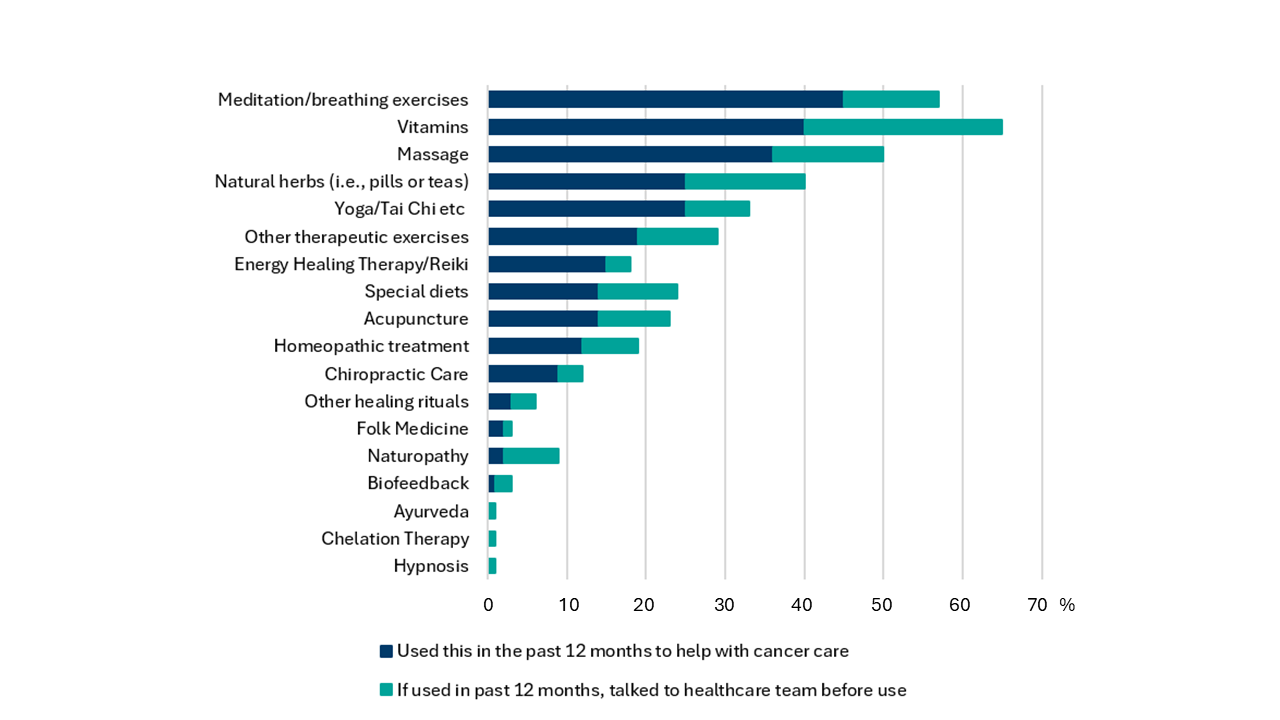
We asked about 18 approaches, from meditation and hypnosis to herbs and special diets. At least one person reported using every therapy on the list. The most common choices were supplements such as herbs, vitamins, or homeopathic products along with meditation, yoga, and massage. If you are considering a supplement or another complementary approach, we urge you to talk with your healthcare team first. Some products, including St. John’s wort, can interact significantly with cancer treatments.
Together, these responses gave our Patient-Focused Research Team more than a snapshot of individual choices. By listening for common questions, concerns, and priorities, the team can identify where patients and families need clearer information and stronger support.
Surveys are only one way our Patient-Focused Research Team listens. Each year, we also host listening sessions so attendees can describe their experiences in their own words. This year, we focused on people living with HER2-mutant lung cancer. As new treatments become available, patient experiences are changing too, and we wanted to understand what those changes look like in everyday life. HER2 mutations occur in about 2% of adenocarcinomas, a type of non-small cell lung cancer.
The listening session revealed several challenges that repeatedly shaped people’s experiences with HER2-mutated NSCLC: a rapidly changing treatment landscape, a complicated path to diagnosis, barriers to accessing care, limited educational resources, and very few community supports designed specifically for them.
I can’t find anybody on the web even talking about HER2 unless you have breast cancer. That’s how I eventually found a HER2 specialist. He has some reported talks that he’s done on HER2 lung cancer specifically.
Although some challenges were specific to HER2-mutated lung cancer, others echoed experiences heard across the broader lung cancer community, especially the frustration of trying to access timely tests and treatment.
And yet, some issues are relatable to the lung cancer community more generally.
I've literally shown up for treatment, other things, and they're like, Oh, sorry, your insurance… We can't do the test. I'm like, Well, I'm here. I just drove two and a half hours, so you better figure it out.
Listening is only the beginning. LUNGevity’s Patient-Focused Research Team brings together the results from both the survey and listening-sessions to identify priorities and guide action. These findings will help LUNGevity strengthen information, resources, and support aimed at improving outcomes for the community.
LUNGevity is using findings from our research to prioritize what we can do to improve outcomes for the community.
Read the full reports:
If you missed a HOPE Summit 2026 session or want to rewatch one you attended, you can find all the recorded sessions here.
If you're interested in joining us for HOPE Summit 2027 in Bethesda, MD, from April 30-May 2, 2027, make sure to fill out our interest list to get notified when registration opens and more details are released.