
Read time: 2 minutes.
New research shows that people living longer with advanced lung cancer are open to discussing end-of-life planning—and want support that addresses both the emotional and practical sides of those conversations.
Advances in targeted therapies and immunotherapies are helping some people with advanced non-small cell lung cancer (NSCLC) live for many years. That progress is changing what survivorship can look like. LUNGevity’s Patient Focused Research Center is studying the evolving needs of patients and drawing attention to areas that are often overlooked, such as end-of-life planning.
Listening to Long-Term Survivors
To better understand patient needs, researchers held focus groups with 12 long-term survivors of advanced NSCLC and five care partners to understand their unmet needs. As part of these discussions, they explored participants’ end-of-life needs which includes the areas of long-term care planning, estate planning, and end-of-life wishes.
Rather than avoiding the subject, participants welcomed the opportunity to talk about end-of-life planning: 94% contributed substantively to the discussion, and none expressed reluctance. They described wanting honest conversations as well as guidance on practical matters such as advanced directives, powers of attorney, wills, future care preferences and “humanistic support” such as support groups to better cope with mortality and uncertainty.
Emotional Support and Practical Guidance
Participants said that societal discomfort around death can make these conversations difficult. They also pointed to gaps in access to clear, practical information on end-of-life planning that could help them and their families prepare for the future. Additionally, participants wanted emotional support for coping with burdens related to uncertainty of life and mortality.
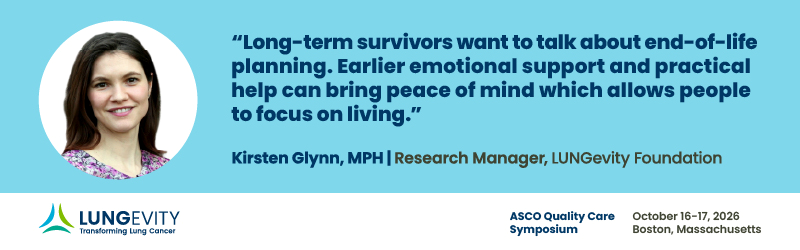
Long-term survivors want to talk about end-of-life planning. Earlier emotional support and practical help can bring peace of mind, which allows people to focus on living.
Kirsten Glynn, LUNGevity’s Research Manager
These findings suggest that end-of-life support should not be reserved for a crisis or the final days of life. Earlier support can give survivors and care partners time to think through their values, document their wishes, and make practical plans at their own pace.
Many of the practical needs participants identified may be addressed with educational materials that already exist. The challenge is making those resources easier to find when people are ready for them and ensuring that people know how to use them.
Watch this 5-minute video of Kirsten talking about this research.
Bringing End-of-Life Planning into Survivorship Care
As treatment advances continue to extend survival, cancer clinics and support organizations have an opportunity to work together to address end-of-life needs proactively. Clinicians can introduce planning as a routine part of survivorship care, while organizations such as LUNGevity can connect people with trusted resources, peer support, and practical guidance.
To see some of LUNGevity’s End-of-Life resources, visit:
- End-of-Life Planning | LUNGevity Foundation
- Virtual Meetups | LUNGevity Foundation has new long-term survivor meetup
- FreeWill | Free tool to create a will online
- Cancer-related estate planning tools
- Patient Perspective on Hospice & End-of-Life Planning
Kirsten Glynn, LUNGevity’s Research Manager, presented this work at the 2026 ASCO Quality Care Symposium in Boston.