
Read time: 5 minutes.
By the time a person starts to experience symptoms of lung cancer, such as worsening cough, wheezing, and chest pain, the cancer has usually spread within the lung or to other parts of the body and is more difficult to treat.
Catching lung cancer early, while a person is asymptomatic, offers the best chance of survival—and sometimes even the possibility of curing the disease.
Like mammograms for breast cancer and colonoscopies for colorectal cancer, low-dose CT scans are used to screen people for lung cancer. (Take this quiz to learn if you are eligible for lung cancer screening.)
The other way lung cancer is detected early is when people get chest scans for other reasons, such as physical injury or unrelated illness, and a suspicious spot is discovered in their lung. These spots, called incidental pulmonary nodules, often don’t get proper follow-up care. This delays diagnosis and treatment, ultimately leading to worse outcomes for patients.
Though Neel Chudgar, MD, was just starting as a thoracic surgeon at Montefiore Einstein Cancer Center, he knew the healthcare community could do better. Supported by one of LUNGevity’s inaugural Health Equity and Inclusiveness Research Awards in 2021, he set out to build a new model for early detection: a lung nodule clinic that makes sure any suspicious findings on CT scans do not get lost or overlooked in the healthcare system.
LUNGevity spoke with Dr. Chudgar about how the research support helped shape a new care model and broadened his path to become a thoracic surgeon and a leader in the early detection of lung cancer.
LUNGevity Foundation: How did your LUNGevity-funded project begin?
Dr. Neel Chudgar: I give a lot of credit to my mentor Brendon Stiles, MD, chief of thoracic surgery and surgical oncology at Montefiore Einstein. We knew the deadline for submitting the application to LUNGevity was coming up, and we began brainstorming around the needs of our patients.
At Montefiore, we serve a diverse patient population in The Bronx, including large Black and Hispanic communities and many patients who face significant health challenges.
Patients in our system often come through the emergency room because access to primary care can be difficult. Those visits often include CT scans or other imaging that reveals incidental lung nodules. The problem is that, in general, less than half of patients with incidental nodules receive appropriate follow-up, and that care gap can be even worse in diverse patient populations.
So, the idea was: Let’s identify patients with incidental lung nodules, make sure they get follow-up, and find cancers earlier, when they are most treatable and often curable.
LF: Can you describe the original vision of the lung nodule program?
NC: The original plan was to have a lung nodule tracking program that would use natural language processing to identify nodules through electronic medical records and place patients into a workflow for follow-up.
That system was delayed, so we created a manual referral in our electronic health system and tracked patients individually to ensure they were getting proper follow-up care. That made the work harder, but it also allowed us to implement the program quickly and start helping patients.
We don’t let them get lost in the system.
-Dr. Neel Chudgar, Montefiore Einstein Cancer Center
LF: What impact has the program had so far?
NC: We paired the lung nodule clinic with our hospital’s existing lung cancer screening program. Between the incidental nodule and screening pathways, we have helped more than 1,500 patients receive appropriate follow up care.
So far, we diagnosed over 100 cancers with about 60 stage I cancers. That is exactly what we are trying to do: find cancer earlier.
When we look at lung cancer stage at Montefiore Einstein, we have also seen an encouraging shift. From 2016 to 2019, stage I lung cancers represented about 25% of cases. In 2025, that number rose to around 48%.
In addition to the lung nodule program, there were other factors that also contributed to this stage shift. But it’s clear to me that this program changed the mentality within our hospital system. It has reinforced the importance of finding cancer early, when it is most likely to be curable.
One of the things we are proud of is that while 97% of patients with incidental findings on CT scans don’t have cancer, the 3% who do have cancer can now be found earlier because we are building systems to ensure they get the care they need.
-Dr. Neel Chudgar, Montefiore Einstein Cancer Center
LF: Has the lung nodule clinic influenced care beyond lung cancer?
NC: Yes, and that has been really rewarding. The lung nodule clinic has become a template for other organ systems. Colleagues working in hepatobiliary, thyroid, and adrenal programs also see incidental findings on scans, and they have asked how they might establish something similar in their disease spaces.
LF: Do you see this model expanding beyond Montefiore?
NC: Really this model could be applicable to hospital systems anywhere.
Initially, the clinic was primarily in two of our hospitals. Montefiore is an eleven-hospital system, and because we share the same electronic medical record, there is a natural opportunity to expand to other hospitals in the system.
With the success of the initial program, we’ve expanded the lung nodule clinic to 3 other hospitals within our system in coordination with an automated nodule tracker.
LF: How has this award affected your career goals?
NC: Personally, I have benefited greatly from the LUNGevity award. I am still in the first years of being an attending thoracic surgeon, and this project has helped shape what I will do with my career. It has opened opportunities to participate in discussions at the national level, such as LUNGevity’s Early Lung Cancer Center, the National Lung Cancer Roundtable, and the Society of Thoracic Surgeons.
It has also helped me think about policies and regulations. I’m not formally trained in policy, but expanding lung cancer screening and early detection nationally can only happen with policy changes.
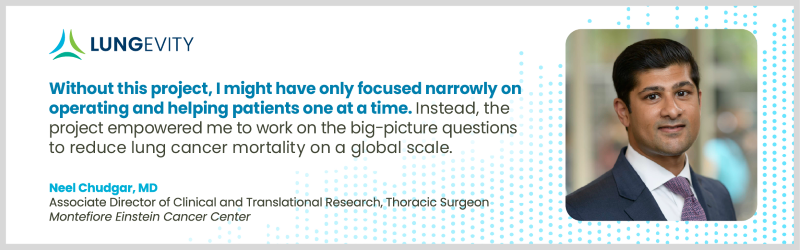
Overall, the project funded by LUNGevity helped position my future career as an academic thoracic surgeon. Without this project, I might have only focused narrowly on operating and helping patients one at a time. Instead, the project empowered me to work on the big-picture questions to reduce lung cancer mortality on a global scale.
LF: What comes next for your research?
NC: I want to continue balancing clinical practice with academic work and research. Within early detection, I am especially interested in lung cancer screening among patients who don’t meet the current criteria for screening, which is a large population in our hospital system.
We will also continue learning from the data generated through the lung nodule clinic. That data can help us improve risk prediction, strengthen follow-up pathways, and support the larger goal of finding lung cancer earlier.
LF: What do you hope people take away from this work?
NC: This work shows that early detection is not only about developing new technology. It is also about building systems that help people access care. If we can recognize suspicious findings, connect patients to follow-up, and act earlier when cancer is present, we can make a real difference.
LUNGevity’s support gave us the ability to build that system, learn from it, and think about how it can grow. My hope is that this model continues to expand—within Montefiore, across other health systems, and ultimately to more patients who can benefit from earlier detection.
More LUNGevity Funded Research Projects: