
Read time: 1 minute.
When people hear the phrase “low grade” in cancer treatment, it can sound reassuring. But for patients, a side effect that is not life-threatening can still shape everyday life in significant ways. That is the central message of this research: “low grade” does not necessarily mean “low impact.” In an oral presentation at the 2026 World Conference on Lung Cancer in Seoul, South Korea, Bellinda King-Kallimanis, PhD, of LUNGevity Foundation, shared research focused on patient-reported low-grade diarrhea during lung cancer treatment.
The study looked at patients on treatment who completed at least four of the first six monthly assessments and reported mild diarrhea on at least three assessments
Key findings included:
- Among 394 Project PEER participants who had been on treatment in the first six months, 81 reported persistent low-grade diarrhea.
- Participants with persistent low-grade diarrhea were similar to those without low-grade diarrhea in age, gender, stage, year diagnosed, and overall ratings of side-effect severity.
- The findings reinforce that patient-reported symptoms can reveal burdens that may not be obvious from clinical reporting of side effects.
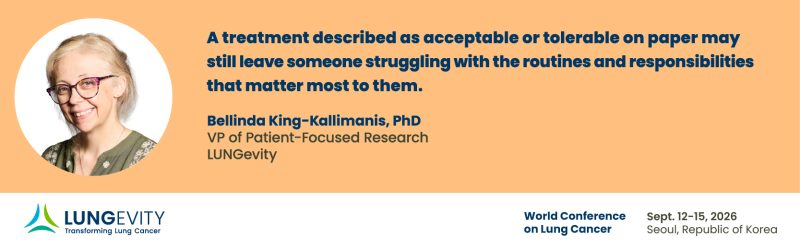
“A treatment described as acceptable or tolerable on paper may still leave someone struggling with the routines and responsibilities that matter most to them,” said Dr. King-Kallimanis. “Listening to patients directly helps us understand treatment tolerability in a more complete and human way.”
Takeaway and next steps: As lung cancer treatment continues to evolve and there are more long-term survivors, the impact of treatment on quality-of-life matters. Researchers, clinicians, and advocates need to keep asking how persistent symptoms affect daily functioning, independence, and quality-of-life and then use that information to support better conversations and care decisions recognizing that it can be enough to acknowledge that these low-grade side effects impact how people live with lung cancer.
Want to learn more about patient-reported outcomes and Project PEER? Email Bellinda King-Kallimanis, PhD, Vice President of the Patient-Focused Research Center at LUNGevity Foundation at [email protected].