
Read time: 3 minutes.
Research funders are increasingly calling on researchers to move beyond studying communities to actively involving them in the research process. They want real input from patients and caregivers as the studies are being designed, executed, and the findings shared. But for most people, research can feel intimidating.
LUNGevity’s Citizen Scientist Program helps bridge this gap. “We are offering an immersive training program to help community members feel empowered when engaging with research, and to ensure their involvement is meaningful, not just a formality,” said Bellinda King-Kallimanis, PhD, head of the Citizen Scientist Program and vice president of LUNGevity’s Patient-Focused Research Center (Patient FoRCe).
Over the past several months, the first Citizen Scientist group has grown into an active learning community. Patients and caregivers have strengthened their understanding of patient-centered comparative effectiveness research (CER) and learned how research actually works behind the scenes with the Patient FoRCe research team.
What is Patient-Centered CER?
Comparative effectiveness research (CER) aims to address patients’ most pressing needs by scientifically comparing different interventions (e.g., medical treatments, services) to find what works best for patients in the real world.
Through a 6-month series of mini-lectures, research article discussions, and interactive case studies, participants learned how to ask questions to make studies more patient-friendly, to improve study designs, and to collaborate effectively with research teams
Building Confidence to Speak Up and Shape Research
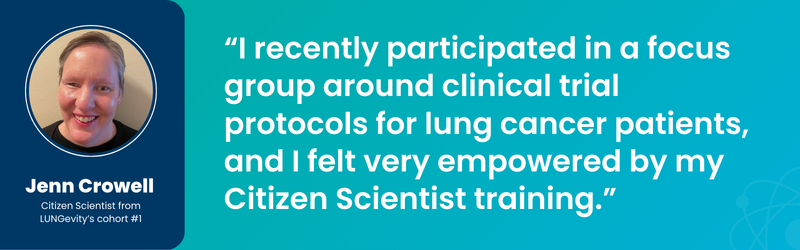
One participant, Jenn Crowell, shared how the program transformed her confidence and ability to participate in research discussions:
I recently participated in a focus group around clinical trial protocols for lung cancer patients, and I felt very empowered by my Citizen Scientist training during the interaction. I was able to ask hard-hitting questions and provide well-informed feedback that will hopefully benefit our community, and Citizen Science gave me newfound confidence in my advocacy skills.
Jenn’s story showcases why this program matters: when people with lived experience have the tools to understand and evaluate research, they can help studies align with what patients actually need.
From Learning to Real Research
This is an exciting time for LUNGevity’s Citizen Scientist Program. The inaugural Citizen Scientist group is now meeting with lung cancer experts to explore opportunities to contribute to active research projects. This is an important milestone that helps them work toward their long-term goal of improving lung cancer research in the real world. LUNGevity will continue following their progress and sharing updates as their work begins to influence real studies and outcomes.
Applications for the next Citizen Scientist group are now open, welcoming more patients and caregivers into this growing community that will reshape the future of lung cancer care. This new group will begin their training in May 2026.
Supporting the Next Generations of Citizen Scientists
LUNGevity’s Citizen Scientist Program—part of our Patient-Focused Research Center (Patient FoRCe)—was created to make sure that lung cancer research truly reflects the needs and experiences of the people it aims to help. The Citizen Scientist Program is supported by an award from the Patient-Centered Outcomes Research Institute.
You can help us continue empowering the voices of people living with lung cancer—donate today.