
Read time: 2 minutes.
The LUNGevity Conversations that Count speaker series offers an opportunity to stay informed, engage in critical discussions, and learn from top experts revolutionizing lung cancer care for underserved populations. The series is intended for healthcare professionals, community health equity champions, and anyone interested in equitable access to healthcare.
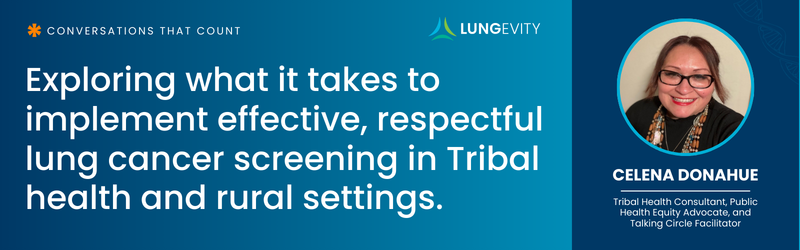
In February, we welcomed Celena Donahue to explore what it takes to implement effective, respectful lung cancer screening in Tribal health and rural settings. Drawing from direct partnership with Tribal communities, she shared key lessons learned—what has worked, where approaches have fallen short, what critical gaps remain, and the next steps needed to advance culturally responsive, community-led screening programs. The full recording of Celena's conversation is available below.
Celena opened by providing essential historical context, outlining how colonization and federal policies—such as forced assimilation and displacement—have created historical trauma that continues to shape health outcomes for American Indian/Alaska Native communities. She emphasized that historical trauma is less about consciously holding onto the past and more about ancestral memory that influences present-day experiences with health and healthcare systems.
A central theme of her presentation was that culture is prevention. Celena described how effective lung cancer prevention and early detection efforts must honor traditional knowledge and cultural practices, including the important distinction between traditional tobacco—used as medicine, offering, or gift—and commercial tobacco.
She noted that American Indian/Alaska Native communities face disproportionately high lung cancer mortality and are often diagnosed at later stages due to barriers such as limited access to screening and specialty care, geographic isolation, and mistrust of healthcare systems. Addressing these challenges requires approaches that are rooted in community, culture, and relationships.
Celena also shared strategies that have helped maximize engagement in her work, including the importance of listening sessions, introductions through trusted community leaders, respect for cultural protocols and timelines, and partnerships with tribal health clinics, IHS programs, and Community Health Representatives. She highlighted best practices for building trust in lung cancer screening conversations—acknowledging historical harms, using plain language and culturally relevant messaging, and framing screening as a choice and a way to care for family and future generations. Trust, she emphasized, is built over time through transparency, consistent presence, follow-through, and shared decision-making—including sharing data with communities.
Key takeaways:
- Early lung cancer detection in American Indian/Alaska Native communities is possible when efforts are built on trust and cultural grounding
- Culturally responsive care requires humility, patience, and accountability, and sustainable progress comes from walking alongside communities, not leading from ahead
- Invest in relationship-building, community partnerships, and policies that support culturally grounded, community-driven prevention and early detection efforts
More Conversations that Count: