
The LUNGevity Conversations that Count speaker series offers an opportunity to stay informed, engage in critical discussions, and learn from leading experts advancing lung cancer care for people who experience barriers to accessing high-quality care.
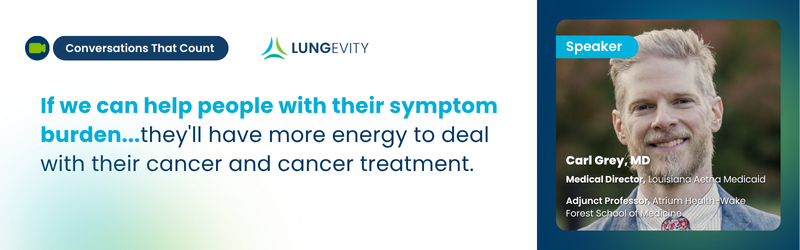
In August, we welcomed Carl Grey, MD, Medical Director for Louisiana Aetna Medicaid and Adjunct Professor at Atrium Health Wake Forest School of Medicine, to discuss “Improving Palliative Pain Management in Response to Improving Cancer Prognoses.” Dr. Grey is a geriatrician with additional certification in addiction medicine—a field he pursued after recognizing the challenges associated with inappropriate opioid prescribing and its long-term effects on patients. His presentation explored the evolving role of palliative care and pain management as advances in cancer treatment continue to improve outcomes and extend survival.
You can watch Dr. Grey's full presentation at the bottom of this page.
Dr. Grey began by clarifying several concepts essential to understanding modern cancer care. He emphasized the importance of patient-centered language, noting that “advanced cancer” is often more appropriate than “incurable cancer.” He also reviewed the role of immune checkpoint inhibitors, terminology related to opioid misuse and opioid use disorder, and the multidisciplinary nature of palliative care. Throughout the presentation, he stressed that palliative care is not limited to end-of-life care. It can be provided alongside cancer-directed treatment for months or even years, offering an additional layer of support for people living with serious illness.
A central theme of Dr. Grey’s presentation was the growing evidence that palliative care can improve both quality of life and survival for people with advanced cancer. He discussed research demonstrating that although modern cancer therapies can be highly effective, patients may experience a significant symptom burden—particularly pain—early in treatment. Palliative care can help address these challenges by managing pain, improving mobility and energy levels, supporting emotional well-being, and reducing overall symptom burden, all of which may contribute to better patient outcomes.
Dr. Grey also addressed the complexities of opioid prescribing in cancer care. While patients with advanced cancer deserve the highest quality pain management, clinicians must also consider the potential risks associated with long-term opioid therapy, including tolerance, physical dependence, misuse, and opioid use disorder. He discussed historical approaches that relied heavily on increasing doses of long-acting and short-acting opioids, noting that these strategies can contribute to tolerance and ongoing dose escalation—even after a patient’s cancer has stabilized or improved.
He also discussed opioid rotation, a strategy that takes advantage of incomplete cross-tolerance among medications. By carefully transitioning a patient to a different opioid, clinicians may be able to improve pain control while potentially reducing the need for escalating doses.
Communication and shared decision-making were key components of Dr. Grey’s approach. He described using motivational interviewing techniques, including the FRAMES framework, to build trust, identify barriers to change, align treatment goals, and empower patients to participate actively in decisions about their care. He emphasized that meaningful progress often occurs incrementally and that even small steps toward change can lead to better outcomes.
Dr. Grey also highlighted persistent inequities in pain management across the United States, noting that people of color do not always receive the same quality of pain assessment and treatment as other patient populations. Addressing these disparities requires sustained attention to equitable, patient-centered care and open, trusting communication between clinicians and patients.
More Conversations that Count: