
Read time: 4 minutes.
The LUNGevity Conversations that Count speaker series offers an opportunity to stay informed, engage in critical discussions, and learn from leading experts advancing lung cancer care for people who experience barriers to accessing high-quality care.
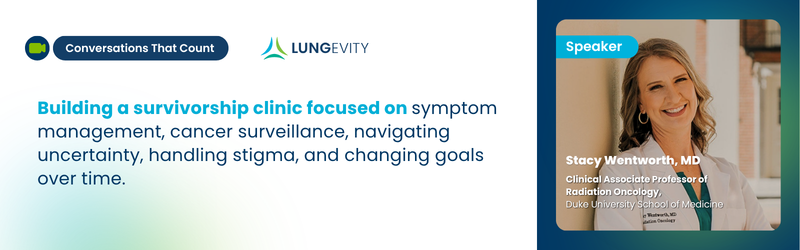
In October, we welcomed Stacy Wentworth, MD, Clinical Associate Professor of Radiation Oncology at Duke University School of Medicine. She's the founder of the Substack newsletter Cancer Culture, a Webby Award-nominated podcast producer, and joined us to discuss "Long-Term Survivorship in Lung Cancer: What Is It, What Do Survivors Need, and Where Do We Start?"
Dr. Wentworth shared insights from her experience developing a lung cancer survivorship clinic and explored how survivorship care can address the complex physical, emotional, and practical needs of patients living beyond a lung cancer diagnosis.
You can watch Dr. Wentworth's full presentation at the bottom of this page.
Dr. Wentworth began by asserting that survivorship care is an increasingly important component of modern lung cancer care as advances in treatment continue to improve outcomes and extend survival. She distinguished survivorship from patient navigation, explaining that survivorship represents a distinct phase of the cancer journey that requires specialized attention and support. While survivorship is considered a standard of care, she stressed that it is not a one-size-fits-all approach and should instead be personalized based on each patient's individual risks, needs, and goals.
A central theme of Dr. Wentworth's presentation was the importance of creating integrated, patient-directed survivorship programs that extend beyond disease surveillance. She discussed how survivorship clinics can:
- Help patients manage lingering treatment effects
- Monitor for recurrence
- Coordinate care among multiple healthcare providers
- Navigate the uncertainty that often accompanies life after treatment.
She emphasized that survivorship care should be guided by patients' values and priorities, ensuring that care plans reflect what matters most to everyone.
Dr. Wentworth also highlighted the significant role of lifestyle interventions in survivorship care. She noted that many cancer survivors do not meet recommended physical activity guidelines despite growing evidence that exercise can improve quality of life and may contribute to better long-term outcomes. As a result, she encourages healthcare providers to work with patients to develop structured and achievable exercise plans as part of routine survivorship care. Nutrition was another important topic discussed during the presentation. Dr. Wentworth reviewed evidence suggesting that a high-fiber diet may be associated with a reduced risk of cancer progression and death, underscoring the importance of healthy eating habits as part of a comprehensive survivorship strategy.
Drawing on feedback from her institution's survivorship clinic, Dr. Wentworth shared encouraging outcomes demonstrating the value of dedicated survivorship services. She reported that more than 75% of patients found survivorship appointments and treatment summaries extremely helpful, while more than 90% reported a better understanding of their treatment history, side effects, and strategies for coping with ongoing symptoms. These findings reinforce the impact that structured survivorship programs can have on patient confidence, knowledge, and quality of life.
Dr. Wentworth also encouraged participants to think broadly about the future of survivorship care. She discussed opportunities to apply lessons learned from survivorship research in other cancer types to lung cancer, noting that proactive information-sharing can help accelerate progress without unnecessarily duplicating efforts. She also emphasized the importance of recognizing and supporting caregivers and care partners, who often experience their own survivorship journey alongside patients.
Finally, Dr. Wentworth addressed the challenges of delivering survivorship care within today's healthcare system. Although survivorship services are not always reimbursed, she emphasized that they remain a critical component of high-quality cancer care. She encouraged healthcare providers to advocate for survivorship resources and connect patients with trusted organizations, educational programs, and community support services that can help them navigate life beyond treatment.
More Conversations that Count: